




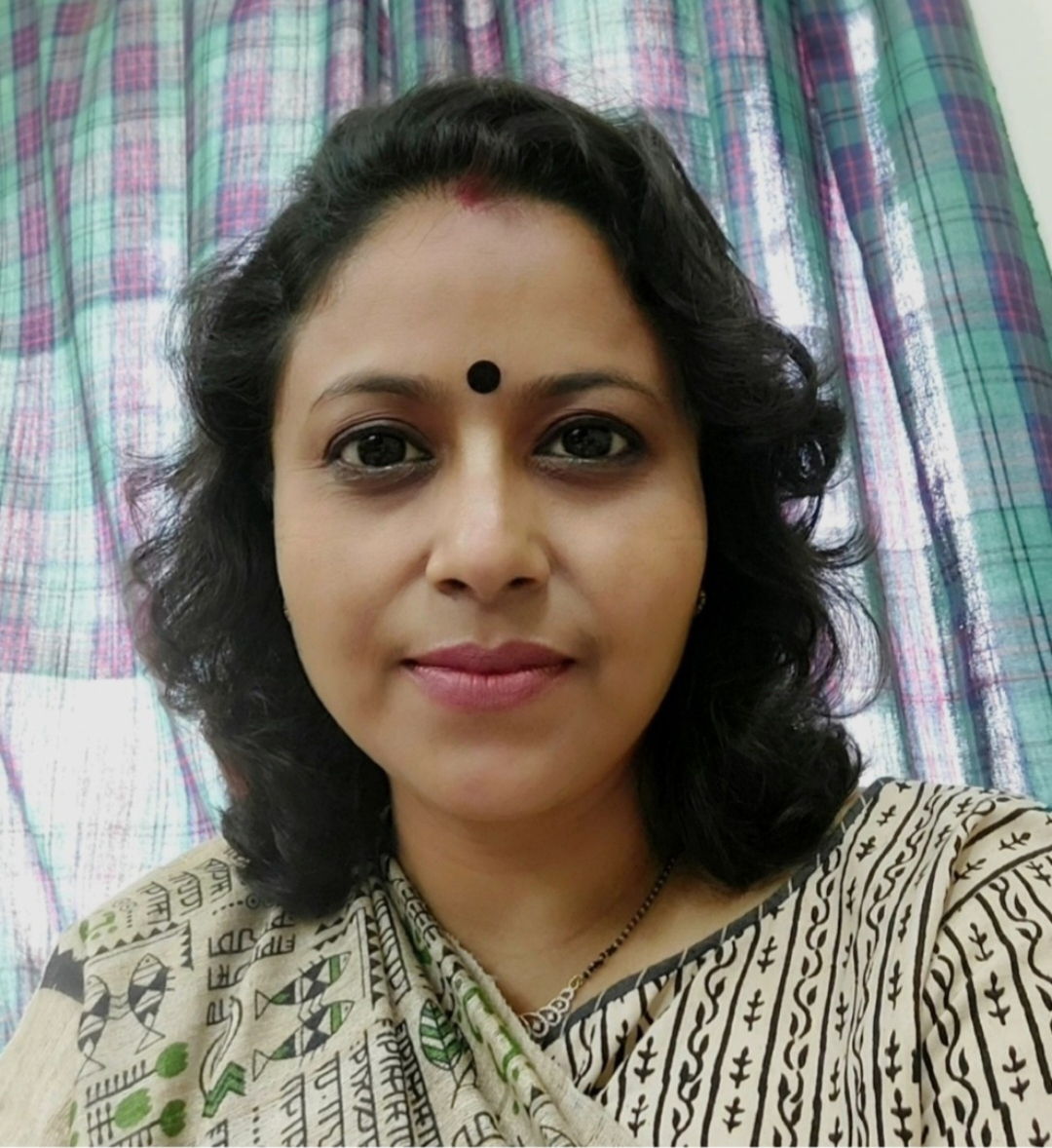
Dr. Neera Sen Sarkar
Associate Professor- Department: Department of Botany
- Phone Number: 9830545889
- Institutional E-Mail: neerabot19@klyuniv.ac.in
- Web URL: https://orcid.org/0000-0002-2001-9126
-
Educational Qualifications:
B.Sc. Botany (Hons.), with First class from Maitreyi College, University of Delhi
M.Sc. (Botany), with First class from Miranda House (Reg.), University of Delhi
B.Ed. with First class from Rabindra Bharati University
Ph.D. (Sc), University of Calcutta (Reg.), Central Inland Fisheries Research Institute (ICAR) under the supervision of Dr. Kumudranjan Naskar
Thesis Title: Taxonomy and ecology of the algal flora of Sundarbans (West Bengal) with special reference to their contribution to the primary productivity of the estuarine ecosystem
Certificate Course on Intellectual Property Rights, WIPO Worldwide Academy, Geneva
Post Graduate Diploma in Intellectual Property Rights, IGNOU -
Teaching Experience:
10+ years of Post Graduate level teaching in the University of Kalyani
3 years of Post Graduate level teaching as Guest Faculty in West Bengal State University
1 semester of Post Graduate teaching as Guest Faculty in Murshidabad University
5 years of Post Graduate level teaching as Guest Faculty in Scottish Church College, University of Calcutta
2 years of Under Graduate level teaching as Part-time Lecturer in Vidyasagar College, University of Calcutta -
Collaborative Programs
Institutional Collaborations:
1. West Bengal Pollution Control Board, Department of Environment, Government of West Bengal
2. West Bengal Biodiversity Board, Department of Environment, Government of West Bengal
3. World Wide Fund for Nature – India, New Delhi
Individual Collaborations:
1. Prof. Joanna Zelazna Weiczorek, Department of Algology & Mycology, University of Lodz, Poland
2. Prof. Punyashlok Bhadury, Professor, Department of Biological Science, IISER, Kolkata
3. Dr. Subrat Mukherjee, Ex PCCF & HoFF, Department of Forests, Government of West Bengal
4. Mr. Debal Ray, PCCF and Chief Wildlife Warden of West Bengal, Department of Forests, Government of West Bengal
5. Dr. Ramkrishna Saha, Chief Scientist, West Bengal Pollution Control Board, Department of Environment, Govt. of West Bengal
6. Prof. Swati De, Professor, Department of Chemistry, University of Kalyani
7. Prof. Zahed Hossain, Professor, Department of Botany, University of Kalyani
8. Dr. Subhankar Kumar Sarkar, Associate Professor, Department of Zoology, University of Kalyani -
Research Area:
Ecology and Diversity of Algae and Mangroves in Indian Sundarbans; Diatom taxonomy, ecology, impact and resource utilization; Impact of Algae on Aquaculture; Algae as bioindicators; Phytoplankton studies in the context of climate change; Biodiversity and Conservation; Medicinal Plant utilization and conservation; Intellectual Property Rights
-
Administrative Experiences
Administrative experience (External)
1. Governing Body member of Kalyani Mahavidyalaya (completed 2 tenures since 2015)
2. Member, Committee for Access to Commercial Utilization of Bioresources, West Bengal Biodiversity Board, Dept. of Environment, Govt of West Bengal
3. Member, Committee for Implementation of recommendations of EIA Report of Hon’ble NGT on Rabindra Sarobar, KMDA
Administrative experience (Internal)
1. Coordinator Biodiversity Working Committee, University of Kalyani since 2016
2. Member, Auction Committee, University of Kalyani 2022
3. Member, AQAR Committee, University of Kalyani 2022
4. Member, Establishment Committee for 3 tenures since 2016
5. CPC nominee of the University in the Purchase Committee of the Dept. of Environmental Engineering since 2015
6. Member, Committee for Publication of University News Letter (2016)
7. Convener of Subcommittee for implementation of CBCS in Kalyani University (2016)
8. Member, Library Committee (2017)
9. Member, Intellectual Property Rights (IPR) Cell of University of Kalyani (2016)
10. Member, Committee for printing University Prospectus (3 tenures since 2015)
11. Member of UGBoS (Botany), University of Kalyani -
List of Publications(Peer-Reviewed)
1. Mukherjee, S. & Neera Sen Sarkar (2021). Re-Planning embankments: Vegetative solutions for embankment stability in Indian Sundarbans. Banobithi: Newsletter of the Department of Forests, Govt. of West Bengal (Bonmohotsav Issue) July 2021: 32-41
2. Manjushree Mandal, Joanna Zelazna-Wieczorek & Neera Sen Sarkar (2020). New diatom taxa for the Indian Sundarbans found in short sediment cores. Diatom Research, 35:1, 17-35, ISSN: 0269-249X (P) 2159-8347 (E) DOI: 10.1080/0269249X.2020. 1716851
3. Neera Sen Sarkar & Rana Datta (2020). Biodiversity: In the light of Corona Pandemic. Newsletter of ENVIS RP on Environmental Biotechnology. Volume 36(2): 2020; pp. 3-7. ISSN: 0974-2476
4. Manjistha Dasgupta, Asok Ghosh, Subrat Mukherjee and Neera Sen Sarkar (2018). Zonation pattern of different mangrove species in the Sundarbans Tiger Reserve, India. Advance Research Journal of Multidisciplinary Discoveries. 24(4):25-38. ISSN No.: 2456-1045
5. Manjistha Dasgupta, Asok Ghosh, Subrat Mukherjee and Neera Sen Sarkar (2018). Influence of soil texture on nature of mangrove vegetation in Sundarbans Tiger Reserve forest of India. International Journal of Environment, Agriculture and Biotechnology. 3(2): 656-662. ISSN:2456-1878
6. Sarobi Das and Neera Sen Sarkar (2018). Fish Poisoning Events in India vis-a-vis, Harmful Algal Blooms: A Review. Eco-Chronicle, 13(1): 36-42. ISSN: 0973-4155
7. Jimi Banik, Anupam Paul, Sudipta Mukherjee, Saikat Paul, P. D. Ghosh and Neera Sen Sarkar (2018). Practicing Economy of Nature through Traditional Rice Variety Conservation: A Case Study from West Bengal, India. Research & Reviews: Journal of Botany; 6(3):20-35. ISSN: 22782222.
8. Sumit Manna, Ria Ghosh, Neera Sen Sarkar, and Anirban Roy (2017). Diversity and Association Analysis of Algal Periphyton community on Hydrilla verticillata, Vallisneria spiralis, and Ceratophyllum demersum. Research Journal of Pharmaceutical, Biological and Chemical Sciences. 8(2):1232-1240. ISSN: 0975-8585.
9. Biswajit Biswas and Neera Sen Sarkar (2017). Morphological descriptors of different species of diatom Cyclotella (Kutzing) Brebisson in the surface sediments of Indian Sundarbans. Phykos; 47(2): 105-116. ISSN: 0554-1182.
10. Srijonee Choudhury and Neera Sen Sarkar (2017). Algae as Source of Natural Flavour Enhancers – A Mini Review. Plant Science Today. 4(4): 172-176. ISSN: 23481900 http://dx.doi.org/10.14719/ pst.2017.4.4.338. Scopus indexed
11. Akhand, Anirban, A. Chanda, S. Dutta, S. Manna, S. Giri, S. Das, A. Mukhopadhyay, A. A. Lotliker, K. Chakraborty, Neera Sen Sarkar, P. Sanyal, S. Hazra & K.H. Rao (2016). Microphytoplankton species assemblages and nutrient stoichiometry in a shallow continental shelf of the northern Bay of Bengal during winter. Indian Journal of Geo-Marine Sciences. 46(9):1827-1835. ISSN:0975-1033(online); ISSN:0379-5136(print). SCI Indexed
12. Mandal, Manjushree, Biswajit Biswas, Sanoyaz Sekh & Neera Sen Sarkar (2016). Diatoms in sub-surface sediment cores from mangrove forest floors of deltaic islands in Sundarbans, India. Journal of Bombay Natural History Society, 112(2): 72-82. ISSN:0006-6982(print); ISSN:2454-1095(online).
13. Mandal, Ranju Prasad, Sanoyaz Sekh, Neera Sen Sarkar, Dipankar Chattopadhyay & Swati De (2016). Algae mediated synthesis of cadmium sulphide nanoparticles and their application in bioremediation. Materials Research Express, 3(2016):05-5007, SCI Indexed
14. Sekh, Sanoyaz, Biswajit Biswas, Manjushree Mandal & Neera Sen Sarkar (2016). Seasonal dynamics of the Genus – Planktoniella Schutt in the estuarine waters of Indian Sundarbans. Accepted for Publication in SpringerPlus (Earth & Environmental Science Section). (2016) 5:611, 1-14; SCI Indexed; ISSN: 2193-1801.
15. Mandal, Manjushree & Neera Sen Sarkar (2015). Study of diatom flora in geothermal springs of Bakreswar, West Bengal, India. Research & Reviews: Journal of Botany; 4(2): 6-10. ISSN: 2278-2222.
16. Mandal, Manjushree, Biswajit, Biswas & Neera Sen Sarkar (2015). Diatom assemblages in soil: Implications in palaeo-ecological interpretations. Research & Reviews: Journal of Botany; 4(1): 16-25. ISSN: 2278-2222.
17. Paul, S. S., B. Mallik, Manjushree Mandal, Biswajit Biswas, Sanoyaz Sekh & Neera Sen Sarkar (2016). Epilithic diatoms as biological water quality indicators-A study in three geographically isolated hill streams in India. Journal of Environmental Biology, 37(2):275-283. ISSN:0254-8704 (print); ISSN:2394-0379 (online); SCI Indexed
18. Dhar Sangeeta, Debal Ray & Neera Sen Sarkar (2014). Trend analysis of research on arsenic pollution in West Bengal, India. Journal of Energy, Environment & Carbon Credits; vol. 4(3):25-42. ISSN: 2249-8621.
19. Sen Sarkar, Neera & Sanoyaz Sekh (2014). Algal resources in the Indian coastal and marine systems with special reference to Sundarbans. Research & Reviews: Journal of Botany; vol. 3(2): 11-19. ISSN: 2278-2222.
20. Mukherjee, S & Neera Sen Sarkar (2013). The range of prey size of the Royal Bengal Tiger of Sundarbans. J. Ecosystems. ISSN: 2314-6001 (Online). DOI:10.1155/2013/351756.
21. Sen Sarkar, Neera, T. Bandyopadhyaya, S. Datta & S. Das (2013). Algae in the assessment of industrial effluents: A case study in South Bengal, India. Journal of Environmental Pathology, Toxicology & Oncology. J. Environ. Pathl. Toxicol. Oncol. DOI:10.1615/2013007425. ISSN: 0731-8898; Scopus Indexed
22. De, B. K., J. D. Patel, S. Verma & Neera Sen (2007). Lipid Composition of Four Algal Species Collected from the Sea Shore of Diu. Jour. Oil Tech. Ass. India, 39(1): p.3-5. ISSN-0970-4094.
23. Ghosh, A., Neera Sen & K. R. Naskar (2004). Host specificity of Mistletoes, Semi – parasites and Epiphytes occurring in the Sundarbans Mangals. Sci. & Cult. 70(1-2): 71 – 73. ISSN:0036-8156.
24. Ghosh, A., Neera Sen & K.R.Naskar (2003). Dodoneae viscosa (L.) Jacq. an occasional plant species in the coastal area facing intertidal zone of Sundarban Tiger Reserve. Seshaiyana 11(2): 3-4.ISSN: 0971-8656.
25. Chakroborty, S., S. C. Santra, Neera Sen & K. R. Naskar (2003). A new record of benthic algae in Indian Sundarbans. Seshaiyana 11(1):8–9. ISSN:0971-8656
26. Ghosh, A., S. Mukherjee, Neera Sen, Manjistha Dasgupta & K. R. Naskar (2003). Floral diversity of mangroves and mangrove associated species in the Indian Sundarbans with special reference to distribution and abundance. J. Indian Soc. Coastal agric. Res. 21(1): 53 – 58.
27. Sen, Neera, K. R. Naskar, S. Chakroborty & S. C. Santra (2003). New benthic alga from Indian Sundarbans. Phykos 41 (1&2): 63 – 64. ISSN: 0031-8892
28. Ghosh, A., S. Mukherjee, Neera Sen, Manjistha Dasgupta & K. R. Naskar (2002). Latest check-list of mangroves and mangrove associated species in the Indian Sundarbans with special reference to distribution of different species. Seshaiyana 10(2): 3-5. ISSN: 0971-8656
29. Sen, Neera, Saikat Naskar & K. R. Naskar (2002). Taxonomy of the diatom flora of Sundarbans mangals in West Bengal, India. J. Interacademicia, 6(2):118 – 137. ISSN: 0971-9016
30. Sen, Neera, K. R. Naskar & B. K. De (2002). Fatty acid composition of the lipids of different halophytic algae from estuarine habitats of the Indian Sundarbans-II. J. Oil Tech. Asso. India, 34(1): 13 – 16. ISSN-0970-4094.
31. Sen, Neera & K. R. Naskar (2002). Algal communities in the inter tidal mangrove niches of Sundarbans. J. Interacad. 6(4): 420 – 433. ISSN: 0971-9016
32. Sen, Neera & K. R. Naskar (2001). Occurrence of a brown algae as littoral flora from the Indian Sundarbans mangals. Seshaiyana 9(1): 1 – 2. ISSN: 0971-8656
33. Sen, Neera, Sasanka Baidya, Bratati Bagchi & Kumudranjan Naskar (2001). Food and feeding habits of the estuarine fish Scatophagus argus (L.) Day from the Sundarbans mangals of West Bengal. J. Interacad. 5(1): 87 – 90. ISSN: 0971-9016
34. Sen, Neera & K. R. Naskar (2000). Colpomenia sinuosa – a new report of brown algae from the Indian Sundarbans. J. Indian Soc. Coastal agric. Res. 18(2): 177 – 179.
35. Sen, Neera, K. R. Naskar, D. K. Bhattacharya & B. K. De (2000). Fatty acid composition of the lipids of different halophytic algae from estuarine habitats of the Indian Sundarbans, J. Oil Tech. Asso. India, 32(3): 120 – 123. ISSN: 0971-9016
36. Naskar, K. R., Dolanchampa Sarkar, Neera Sen, R. N. Mandal & A. K. Sarkar (1997). Mangrove ecology of the Indian Sundarbans: It’s impact on the economy and coastal environment. J. Interacad. 1 (1): 49 – 60. ISSN: 0971-9016
37. Naskar, K. R., R. N. Mandal, Dolanchampa Sarkar, Neera Sen & A. K. Sarkar (1997). Investigations on seedling development, vis – a – vis, plantation of Heritiera fomes Buch. Ham., beyond the inter tidal non – saline zones. J. Interacad. 1 (3): 177 – 182. ISSN: 0971-9016.
38. Sen, Neera, Dolanchampa Sarkar, A. K. Sarkar & K. R. Naskar (1997). A note on the algal flora of Sundarbans. J. Interacad. 1(3): 177 – 182. ISSN: 0971-9016. -
Books Published / Book Chapters
BOOK
1. Sen, Neera & Kumudranjan Naskar (2003). Algal Flora of Sundarbans Mangals. Daya Publishing House, New Delhi. xii + 315 pp. ISBN:817035286X.
EDITED BOOKS
1. Mukherjee, Soma Jayanta Kumar Biswas, Neera Sen Sarkar and Ashis Kumar Panigrahi (Eds.). (2020). Vision Towards Environmentally Sustainable Future. Published by New Delhi Publishers, New Delhi, India
2. Sen Sarkar, Neera, S. N. Ghosh & A. Roy (2008). Biodiversity – Issues & Concerns. Proceedings of the Lectures presented on the occasion of International Biological Diversity Day, 2006 in the Seminar “Biodiversity of West Bengal – Documentation and Conservation’, Published by West Bengal Biodiversity Board.
BOOK CHAPTERS
1. Neera Sen Sarkar and Sanoyaz Sekh (2019). Dynamics of Algae in Sundarbans and their implications as climate change proxies. In: The Sundarbans: A Disaster-Prone Eco-Region Increasing Livelihood Security (Ed. H. S. Sen). Coastal Research Library Vol. 30 Series Editor C. W. Finki, Springer Nature, Switzerland. pp. 135-164. ISBN: 978-3-030-00679-2
2. Sarobi Das, Srijonee Choudhury & Neera Sen Sarkar (2019). Impact of phytoplankton assemblages in the Sundarbans ecosystem. In: A. K. Sanyal (Ed.) Wings of Life: Genomics, Biodiversity and Life Processes. Published by The Asiatic Society, Kolkata, India. pp. 132-138.
3. Sen Sarkar, Neera (2017). Algae. State-of-the-Art Report on the Biodiversity of Indian Sundarbans (Eds. A. K. Ghosh & Ajit Banerjee). Published by World Wide Fund for Nature – India, New Delhi in collaboration with The World Bank. pp. 26-46
4. Mukherjee, S., Neera Sen Sarkar, A. Roy & P. Venu (2017). Mangroves. State-of-the-Art Report on the Biodiversity of Indian Sundarbans (Eds. A. K. Ghosh & Ajit Banerjee). Published by World Wide Fund for Nature – India, New Delhi in collaboration with The World Bank. pp. 77-85
5. Sen Sarkar, Neera (2013). Approaches in studying ecology and biodiversity of algae. In: Manual of Cryptogamic Research (Eds. Ruma Pal and Samit Ray). Published by Probir Chatterjee Research Foundation on Cryptogamic Studies.
6. Sen Sarkar, Neera & A. Roy (2012). Spectrum of diversity in Indian flora – An assessment. (Eds. D. Ray, A.K. Sharma & S.N. Ghosh). Publisher Viva Books, New Delhi. pp. 209-242. ISBN: 9788130921136
7. Ghosh, S. N. & Neera Sen Sarkar (2010). Biodiversity – a priceless natural treasure. Environmental Factsheets 2010 (Eds. D. Chakraborty & D. Gupta). Published by West Bengal Pollution Control Board, Dept. of Environment. pp. 84-96.
8. Sen Sarkar, Neera & S. N. Ghosh (2008). Biodiversity conservation through people’s participation: An initiative. Zoological Research in Human Welfare. 33: 333-336. ISBN : 8181712011
9. Naskar, K. R. & Neera Sen Sarkar (2005). Importance of mangrove ecosystems in coastal zone protection. In: A Commemorative Volume of Workshop-cum-Seminar on Embankments of Sundarbans and Related Issues. (Ed. D. P. Jana). Institute of Educational Research & Evaluation, Kolkata. pp. 52 – 61
10. Naskar, K. R. & Neera Sen Sarkar (2004). Estuarine ecology of coastal West Bengal with special reference to Sundarbans mangal. In: The Dying Earth – People’s Action and Nature’s Reaction (Eds. Mamata Desai & M. K. Raha). ACB Publications in association with Netaji Institute for Asian Studies, Kolkata. pp. 171 – 213.
BULLETIN
1. Naskar, K. R., Neera Sen Sarkar, A. Ghosh, M. Dasgupta & B. Sengupta (2004). Status of the mangrove ecosystem of Sundarbans in West Bengal: Its impact on estuarine wetland fisheries. Bulletin No. 134, Central Inland Fisheries Research Institute, ICAR, Barrackpore, Kolkata – 700 120, WB. pp. – 53. -
Invited Lecture / Session Chaired
Invited Lectures
1. Sen Sarkar, Neera (2013). Algal resource utilization and sustainable management. In: Proc. of State Level Seminar on Biodiversity conservation and sustainable management. Berhampur Girls’ College, Murshidabad, West Bengal.
2. Sen Sarkar, Neera (2016). Nomenclatural notes on the diatom Palmerina hardmaniana (Greville) Hasle – its occurrence and significance in the estuaries of Sundarbans. In: National Seminar on Plant and Microbe: Diversity and Utilization; Organized by Department of Botany, Sikhsha Bhavana, Visva-Bharati, Santiniketan – 731235
3. Neera Sen Sarkar (2016). Perplexities of morphology based approach to diatom biogeography: Case studies from Indian Sundarbans. International Conference on The Green Planet: past, present and future. Organised by Department of Botany, University of Calcutta during 21st to 23rd December, 2016.
3. Neera Sen Sarkar (2018). Introduction to Diatom Morphology. In: Proc. of National Seminar on Recent Advancement in Cryptogamic Botany & Workshop; Dept. of Botany, University of Calcutta, Kolkata
4. Neera Sen Sarkar (2018). Urban Biodiversity: Documentation and Conservation. In: Abstract Book of National Seminar on Urban Biodiversity: Documentation and Conservation, Organised by Bethune College during 6th and 7th March, 2018.
5. Neera Sen Sarkar (2018). Algal Resource Utilization: Potential, Progress and Challenges. In: Abstract Book of State Level Seminar on “Biological Sciences in the New Era: Current Progress and Challenges Ahead” at Kaliganj Govt. College, Debagram, Dist. – Nadia, West Bengal
Member, Bombay Natural History Museum
Member, International Society for Tropical Ecology
Member, International Organisation of Palaeobotany
Life Member of Probir Chatterjee Research Foundation on Cryptogamic Research
1. Nominated as Expert in Committee for Protection of Embankments of Indian Sundarbans through Vegetative Solutions by Department of Environment, Government of West Bengal, Post Amphan and Yass disasters
2. Appointed as Expert by the West Bengal Biodiversity Board for discussions on Form-I (NBA) dealing with access to algal resources to Indian scientist working in foreign collaboration
3. Member, Research and Development Advisory Committee of the Susamadevi Chowdhurani Marine Biological Research Society, Sagar Island
4. Appointed as Expert by the West Bengal Biodiversity Board for discussions on Form-I (NBA) dealing with access to algal resources to a CSIR scientist working in foreign collaboration
5. Invited by the Kalyani Municipality for looking into the complain about destruction and killing of full grown trees in Kalyani Municipal area
6. Departmental Representative for attending and presenting at the Review Committee Meeting of DST-FIST at IASc., Bengaluru
7. Member, Technical Committee for Evaluation of Abstracts for the 24th West Bengal State Science & Technology Congress
1. Bengal Shipyards Ltd. and Apeejay Surrendra Enterprise on mangrove area assessment for development of Marine Industrial Park
Research SupervisionGuided 4 Research Scholars for obtaining Ph.D. degree
Presently guiding 4 Research Scholars for obtaining Ph.D. degree